Niagara-on-the-Lake is a historic jewel of a town located twenty minutes north of the waterfall. I was there exploring, this final week of August as summer started to shed leaves over fields and the weather sort of cleaned and sharpened itself into a pre-autumn chill. It was a town of farmer’s markets, tiny chapels, and graveyards. There was a story at almost every corner.
Living Water Wayside Chapel
- We passed by it on a tour bus plowing through a country road. It was a tiny white wooden house with a brass cross. “Ladies and gentleman—the smallest church in Canada!” said the tour guide. I didn’t believe it until I looked it up later that night, and learned that it was in fact Canada’s smallest church, able to fit six people inside, containing pews and even a space for prayer. Usually when places obtain a title like that—“___est in the world”—they become places of tourism and publicity. But not this one. Originally built on a family farm in the 1960s, this chapel is unmanaged and open to anyone in a wide field in Niagara. The farmer’s market across from it, Walker’s Country Market, selling apples and peaches beneath string lights, is more popular.
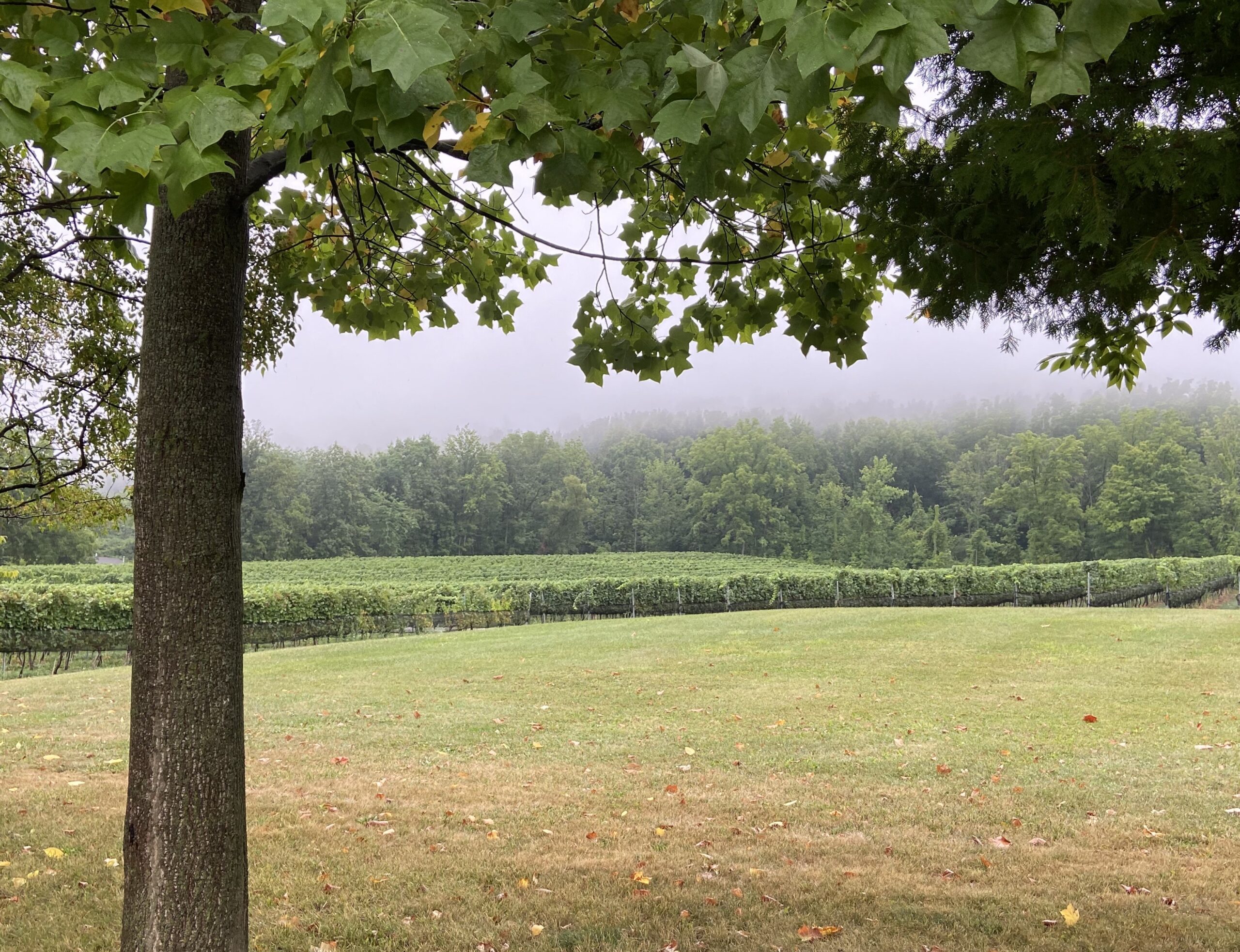
York Vineyards
- Autumn seemed to have already come over the fascinating plantation of York Vineyards. I stumbled upon the historical estate on my second morning and just felt temporarily stunned. Great mists rolled over the rows of grapevines that would be cultivated into sparkling wines. Oak trees fringed the property and the neoclassical mansion, and were shedding leaves in the misty rain. After fringing on the edge of the estate like a dazzled trespasser I hurried away.
Mackenzie Printery
- Has many printing press machines used in the 18th- and 19th centuries to print newspapers. The entire museum is the size of a house, the tour takes about ten minutes, but it’s a robust one that allows you to push levers and press lids to smear ink on the metal type you’ve arranged in the case. It’s a fascinating guide of the history of printing presses and Canadian newspapers since the 1820s.
- Learned that Times New Roman was first created for a British newspaper in the 1900s as a custom commission. Fonts like Caslon and Baskerville (two of my beloved fonts) were also custom-made from this era.
- Learned that the Linotype printing press was named for its function: a line of type, that became line o’ type. I assume this prompted the naming of the font Palatino Linotype, again one of my favorites.
Niagara-on-the-Lake, like its name, is a little phrase but not quite a sentence: it has a rich full story to offer, but only gives you a taste. I loved this taste so much that I plan to be back next year with a pen and a better notebook in my hand.
